The Recruiter Sprint: Your CRM can already do AI

A fortnightly Hume Scope publication for recruitment agency owners, leaders, and consultants.

Read this issue Three reads inside
Your reading list

In this issue.

Three reads, each with one practical idea to take back to your desk or agency.

Feature story

Your CRM can already do AI. Here's what that looks like.

Last issue I said the question to ask of your CRM isn't which one has the best AI. It's whether it can connect to an LLM like Claude. We've had ours connected for a couple of months now. Here's what it's actually changed.

At least once a day an owner tells me they're thinking of switching CRMs to get AI. I get it. But a migration costs more than the invoice. Teams take months to get comfortable, billings dip during the changeover, and plenty of the new AI-first platforms are still missing the basics you'd expect from a recruitment system.

Connecting the system you already have gets you most of the benefit without any of that.

From our live demo
76relevant founder contacts found for one candidate, from a single request
49applicants reviewed against the job description in one go
3 hrsof BD research it can take off your plate for a single call list

Source: Hume Scope's own CRM, shown in our October webinar. Results depend on how your database is set up and how clean it is.

What changes when your database can talk back

  1. You see every desk clearly without chasing anyone. I ask for a consultant's BD activity for the week and get calls made, outcomes, callbacks requested and what's been agreed. One week for a member of our team: 232 notes and 35 live BD conversations, summarised in seconds. When I managed close to 70 people, this alone would have changed my one-on-ones.
  2. Fewer follow-ups fall through the net. High-volume consultants forget things. So do I. Now I get a list of who needs a callback and what was last agreed, and a quick nudge does the rest.
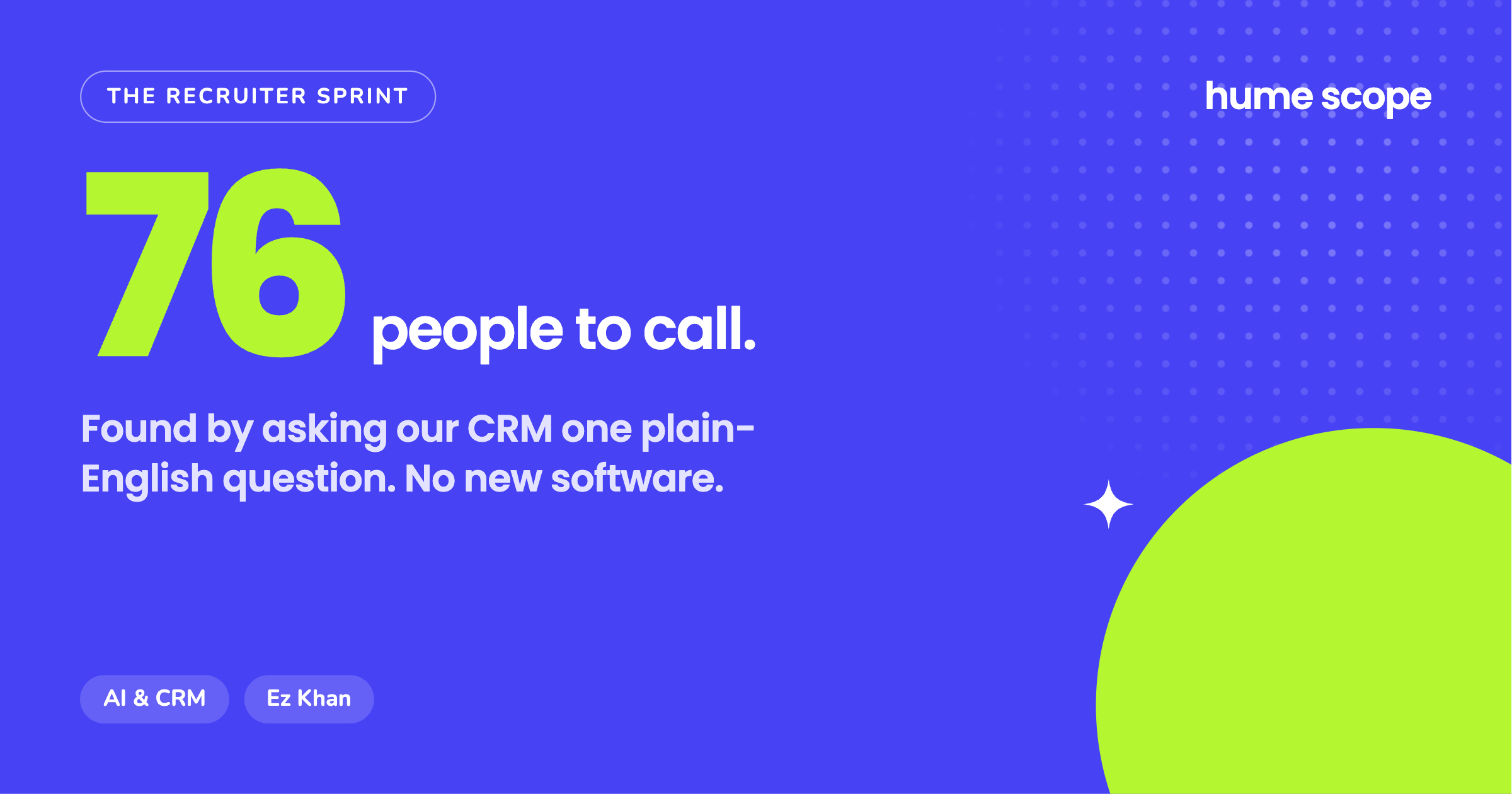
  3. More placements from candidates you already have. I described a candidate and the type of business she'd suit. It found 76 relevant founder contacts in our database, researched the first three businesses and drafted a tailored approach for each. On a client submission, I'd change maybe 10% of the email it drafted.
  4. Your BD starts warm, not cold. Ask it for the senior candidates you interviewed last year, then check who's moved into a hiring role. Or pull contacts with no notes in six months and build a researched call list. That's two to three hours of work most consultants simply never do.
  5. You spend less to find candidates. LinkedIn Recruiter, job ads and sourcing tools keep getting dearer. Searching your own database in plain English means you find the people you've already paid to attract before you pay again.
It makes good fundamentals faster. It won't fix bad ones.

Two cautions

Start read-only. We still haven't switched on edit access, and we're getting huge value without it. And never give anyone permission to download your data in bulk.

The same rule from last issue also applies. If your database is a mess or your team won't pick up the phone, connecting it to AI won't fix that.

The practical takeaway

You don't need a new CRM to get AI. You need the one you've got talking to an LLM, set up around how your team actually works.

What activity does $500K in billings take?

It's a question I get asked a lot. The honest answer: it depends on your own metrics. But if we work off averages, here's what it looks like.

Start with the fee. At an average of $18,000 per placement, $500K means 28 placements. Then work backwards using a few assumptions about your ratios:

  1. You fill 33% of the roles you work on. So you need 84 roles (28 ÷ 0.33).
  2. You send 3 CVs per role. That's 252 CVs (3 × 84).
  3. It takes 4 client meetings to win a role. That's 336 client meetings (4 × 84).
  4. It takes 5 BD calls to land a meeting. That's 1,680 BD calls (5 × 336).
Your annual targets
28placements at an $18K average fee
84roles worked on
252CVs sent
336client meetings
1,680BD calls
$500Kin billings

What that looks like each week

Spread across 48 working weeks, your weekly targets come out at:

Your weekly targets
1.75new roles
5CVs sent
7client meetings
35BD calls

Note: These figures use average assumptions, not your own data. Your ratios will change the numbers.

If that looks unrealistic

Here's the deal. You might need to improve the quality of your activity, not just the volume. There are only so many hours in a week.

Scrutinise your ratios. If you won a role from 3 meetings instead of 4, you'd need 84 fewer client meetings a year to hit the same number.

Doing more isn't always the answer. Getting better at the activity might be.
Free resource

Our Ratio Tracking Sheet

Plug in your own numbers to define your ratios and pinpoint exactly where your activity needs improving. Email me and I'll send it straight over.

Email me for a copy
The practical takeaway

Know your ratios before you set your targets. Improving one ratio can take hundreds of activities off your year.

The work ethic I didn't ask for

Some of the best lessons I've learned in leadership, business and life didn't come from my corporate career or from books. Like most people, I imagine, they came from my upbringing.

I grew up in Birmingham with immigrant Pakistani parents who barely spoke English when they first arrived in the UK. None of my family were in or even around corporate. My dad was a factory worker when he first arrived. He worked multiple jobs and sacrificed a lot to eventually build a pretty decent property empire.

His approach to work was simple. Put in the hours, do more than others are willing to do, be consistent, sacrifice, and eventually it'll pay off. In fact, I was never allowed to hang out with my mates after school.

Instead, Dad would pick me up every single day (and I mean every day, no exaggeration) and we'd head straight to one of the properties he'd bought. Usually a rundown house in desperate need of work. We'd spend hours plastering, lifting floorboards, replacing roof tiles, sometimes even doing electrical work. The rules were pretty lax back then.

At the time, I felt so hard done by. My mates got to go off and play while I had to work. I didn't see the value in it at all.

Fast forward to today, and I'm so grateful for my dad. I didn't understand it then, but he was teaching me lessons I'd carry forever: the value of hard work and sacrifice. They've shaped me as a consultant and a leader. They're the reason I've been able to build a business, push through tough times and keep going when I can't see the end goal.

Black and white portrait of Ez Khan's father as a young man, wearing a suit and tieDad
From the family album

Even when I can't see the tip of the mountain, I keep climbing.

Dad in his youth. Essentially a tradie, but for some reason he always wore a suit.

What it means for leaders

As leaders, we often have to do the hard things. We guide our teams through tough moments and encourage them to put in the hard work, even when they can't see the benefits yet. Sometimes they can't see the bigger picture, so we have to keep them focused on the work that pays off down the line.

That drive and perseverance is something I hope I can pass on to others through our training. So if you're leading a team, remember: the payoff from the tough stuff isn't always visible straight away. Just like my dad taught me, the climb is always worth it.

The practical takeaway

Your team won't always see why the hard work matters yet. Your job is to keep them focused on it until they do.

Recruitment Playbook

We just passed 100 Playbook subscribers.

I built the Playbook so agencies could get proper recruitment and tech training without paying thousands for it. For me, the feedback's been the best part.

There's no lock-in. Work through one course or all of them, then leave whenever you're done. We've never put a minimum term on it.

Most agencies start with the Claude or ChatGPT courses, because they're built specifically for recruiters. Others come for the breadth: Leadership, Retained Search, Personal Branding and the Advanced Recruiter courses.

Explore the Playbook

I'm loving Claude to be honest, it's changed my world!

Ryan Kelly, Creative Natives

Just working through your retained search course, which is superb!

Darren Saul, Saul Recruitment

You've nailed how to keep recruiters engaged with short, sharp bits of information.

Sophia Dufaur, Interface Agency
The people behind the work

Who to talk to.

Ez Khan

Ez Khan

Founder & Principal Coach
Agency growth, training and advisory
Jendahl Martin

Jendahl Martin

CRM & Systems Lead
Database projects, CRM and automation
Email Jendahl ↗
Mark Jabagat

Mark Jabagat

Head of Marketing
Campaigns, content and creative
Email Mark ↗
Anne Felix

Anne Felix

Operations Support
Project coordination and support
Email Anne ↗
Janette Iglesia

Janette Iglesia

Client Engagement Specialist
Client relationships and Recruitment Playbook
Email Janette ↗

Newsletter

Please enable JavaScript in your browser to complete this form.