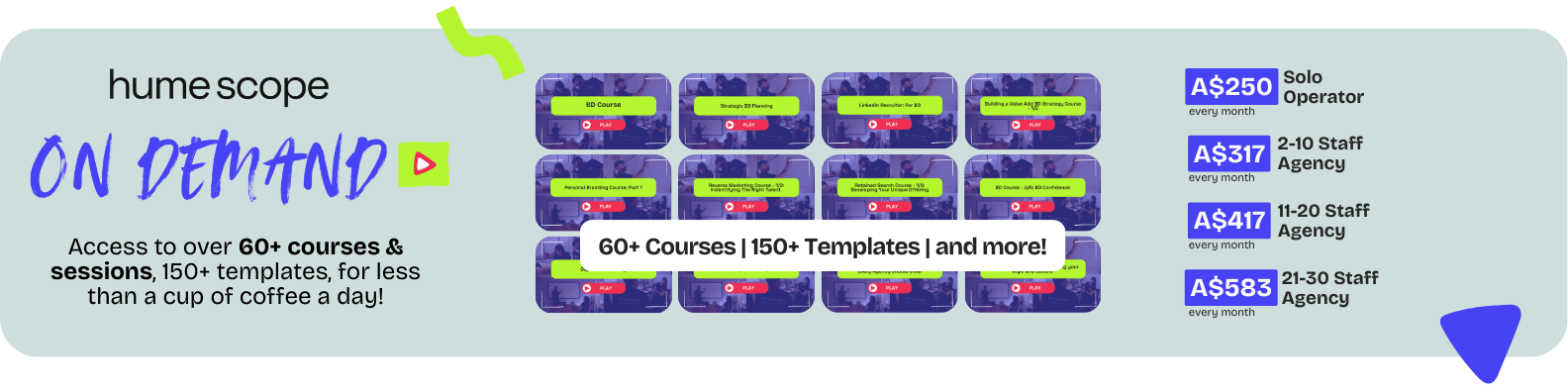
Get access to 60+ recruitment training sessions, practical templates and proven frameworks inside our On-Demand offering, built specifically for recruitment agency leaders and their teams.
After a tough couple of years for agency recruitment, the latest Hume Scope billings data is finally pointing in a more positive direction.
Consultants averaged $103k in the March quarter, senior consultants averaged $125k, and team leaders also averaged $125k.
That is a strong result.
But it does not mean every agency is suddenly performing well.
What the data really shows is a market that is improving while exposing a bigger gap between the agencies that have tightened their fundamentals and the ones still relying on inconsistent activity, reactive BD and unclear processes.
The opportunity is there. But not everyone is set up to capture it.
Across the last quarter, we saw billings lift across consultants, senior consultants and team leaders.
A big increase came from consultants, who moved from $87k in the December quarter to $103k in the March quarter.
Senior consultants increased from $104k to $125k, while team leaders recovered from a December dip, moving from $108k to $125k.
For the first time in a while, the data feels genuinely positive.
But there is another side to it.
The market is rewarding consultants and agencies that have adapted. Those with consistent BD, strong client engagement, clear workflows and proper accountability are seeing the benefit.
Those still operating the way they did in easier market conditions are falling further behind.
For consultants, the highest-performing sectors were:
For senior consultants, Tech & IT bounced back strongly, averaging $172k. Insurance followed at $159k, with Utilities & Energy also performing well.
For team leaders, the strongest sectors were Executive Search, Engineering, and Tech & IT, with Executive Search sitting close to $190k.
Most sectors improved quarter-on-quarter, which is a positive sign for the industry.
But the performance lift was not accidental.
The agencies performing consistently well are not necessarily doing anything complicated.
They are doing the fundamentals better than everyone else.
They have clear processes. They track activity and ratios. They know what their top performers are doing differently. They use AI and offshore support where it actually solves a problem.
Most importantly, they hold people accountable before performance drops, not after.
That is the real difference.
Average agencies react to poor results.
High-performing agencies spot the warning signs early and course correct before the billings fall.
There are four patterns showing up again and again across agencies.
This is one of the biggest performance killers.
From job intake through to aftercare, too many consultants are still working in different ways. Notes are inconsistent. Client rebriefs vary. Candidate processes are unclear. Follow-up is not always happening properly.
That creates lower fill rates, slower speed to market and too much time spent on work that could be streamlined.
The fix starts with mapping the process properly.
What happens from the moment a job is picked up? How long does each step take? Which parts genuinely need a consultant, and which parts could be supported by AI, automation or offshore resources?
Too many consultants still fall into the panic BD cycle.
They have a strong month or quarter, stop client development, focus only on filling roles, and then panic when the pipeline dries up.
By that point, the BD becomes reactive. It becomes more transactional. It often turns into mass reverse marketing, hard sales approaches or rushed outreach that does not create quality conversations.
Consistent performance requires consistent client engagement.
Not only when billings are down.
Not only when jobs dry up.
All the time.
A lot of recruitment leaders were promoted because they were strong billers.
That does not automatically mean they have been trained to lead, coach, motivate or manage performance.
This shows up in inconsistent one-on-ones, delayed performance conversations and a lack of clarity around leading indicators.
Too often, leaders only step in when performance has already dropped.
By then, it is usually too late.
Leaders need to be able to talk about activity, ratios, pipeline, BD quality and performance expectations every week without making it feel like a crisis conversation.
Agency costs are increasing.
Salaries are higher. Tech stacks are more expensive. AI tools are being added quickly. LinkedIn, Seek and other candidate acquisition channels continue to take up more budget.
The agencies handling this well are looking carefully at where consultant time is being spent.
If consultants are spending too much time on admin, formatting, research or repeatable workflow tasks, there is a margin problem.
That does not mean replacing consultants.
It means freeing them up to do the work that actually drives performance: speaking with clients, engaging candidates, influencing process and closing outcomes.
AI and offshore support can both create significant leverage.
But only when they are attached to a specific problem.
The agencies doing this badly are adopting tools or hiring offshore support without a clear brief. They hear about something working elsewhere, bring it into the business and expect it to fix performance.
That rarely works.
The agencies doing this well are mapping their workflows first. They are identifying where time is being lost, where work is repeatable and where consultants are being pulled away from higher-value activity.
Then they test support in one clear area.
That might be research, resume formatting, admin, sourcing, screening support, marketing assistance or job documentation.
The point is not to add more tools or more people.
The point is to remove friction from the process.
If you are an agency owner or leader, there are three areas I would be looking at.
Start by mapping what your top performers are doing.
Look at their activity patterns, ratios, client engagement, job conversion, fill rates and speed to market.
Then compare that against your average and lower performers.
This gives you a factual coaching conversation.
Instead of saying, “I think you need to do more,” leaders can show exactly where the gap is and what needs to shift.
Document your job management workflow from job intake through to aftercare.
Then identify the points where consultants are losing time or where the process is inconsistent.
The aim is not to create process for the sake of it.
The aim is to improve speed, quality and conversion.
Even small improvements can have a major impact if they happen across every role, every consultant and every week.
If leaders are not having consistent performance conversations, the rest of the system will fall over.
Training consultants helps, but it does not stick unless leaders reinforce the behaviours, track the right indicators and hold people accountable.
The key question for agency owners is simple:
Do your leaders know how to identify a future performance drop before it appears in the billings?
If the answer is no, that is the first area to fix.
The March quarter was a positive one for recruitment.
Billings are up. Several sectors are improving. Consultants, senior consultants and team leaders are showing stronger averages than we have seen for some time.
But the real takeaway is not just that the market is improving.
It is that performance discipline matters more than ever.
Agencies that rely on inconsistent BD, unclear processes and reactive leadership will continue to see fluctuating results.
Agencies that tighten the fundamentals will be far better placed to turn one strong quarter into sustainable performance.
The market may be moving again.
The question is whether your team is moving with it.
Most agencies do not need more theory.
They need clearer systems, stronger leadership rhythms and better visibility over where performance is being lost.
If you want support identifying the gaps in your team, improving consultant performance or mapping where AI and offshore support could create better leverage, this is exactly the work we do with agencies through Hume Scope’s advisory, training and systems support.
Get in touch with me if you want to have a conversation about what this could look like in your agency.